

IEP to College Accommodations: The Deadline That Catches Most Families Off Guard
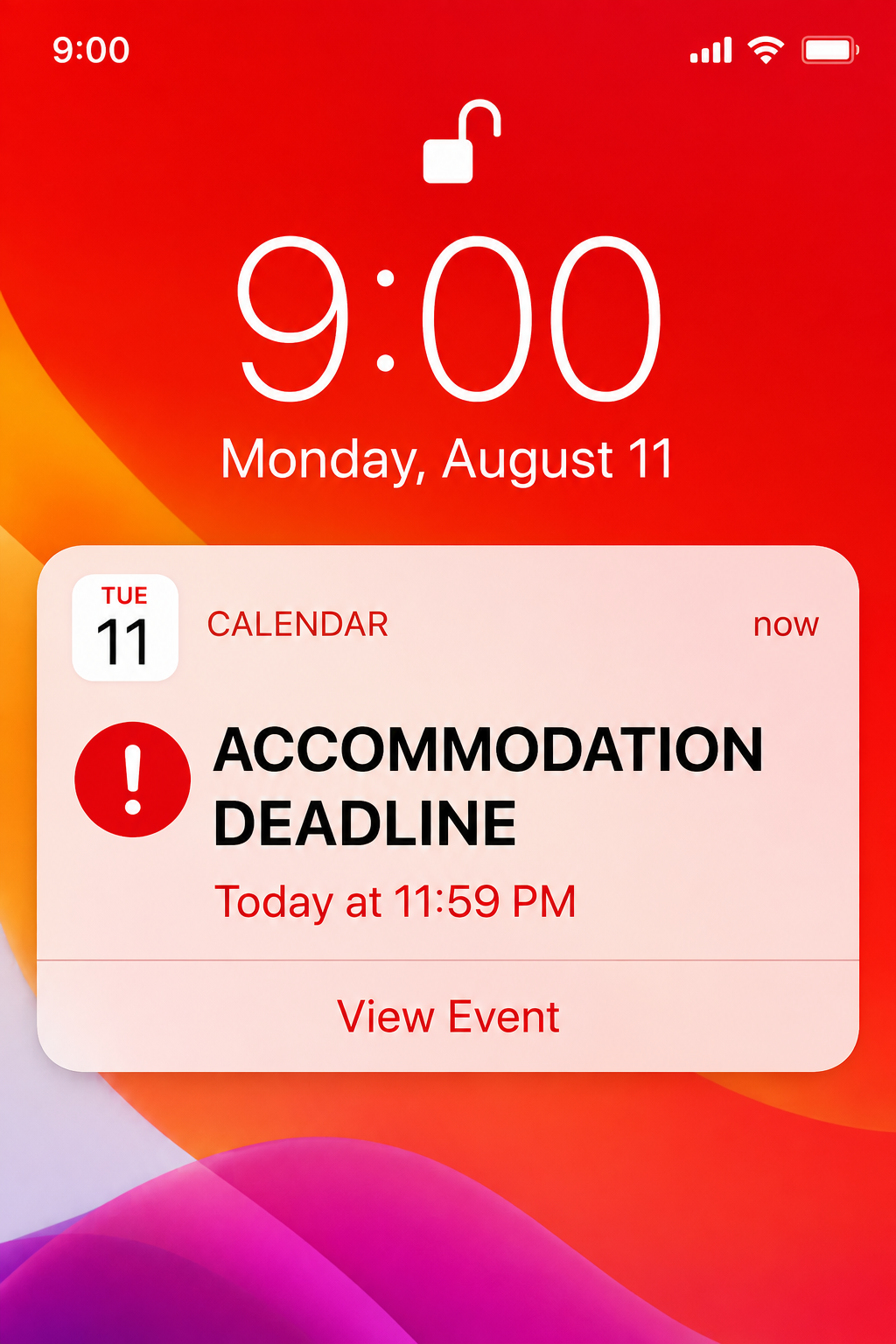
If your student had an IEP or 504 plan in high school, you likely already know that accommodations don't automatically carry over to college. What many families don't realize is that even once a student self-discloses and requests accommodations, most colleges require documentation to be submitted weeks before the semester begins — not during orientation, and not once classes are already underway.
The legal shift nobody explains clearly
In K-12, students are protected under IDEA (the Individuals with Disabilities Education Act), which requires schools to proactively identify students who need support and provide it through an IEP. In college, that law no longer applies. Instead, students are protected under the ADA (Americans with Disabilities Act) and Section 504 of the Rehabilitation Act, both of which require colleges to provide "reasonable accommodations," but only once a student discloses their disability and formally requests support.
This distinction matters because the standard is different too. Colleges aren't required to guarantee success or replicate a high school IEP; they're required to provide equal access. According to the U.S. Department of Education's Office for Civil Rights guide, Students with Disabilities Preparing for Postsecondary Education: Know Your Rights and Responsibilities, postsecondary schools are not obligated to identify students with disabilities on their own, and students must self-identify to the institution's disability services office and provide documentation if requested (U.S. Department of Education, Office for Civil Rights).
Understand why timing matters so much
Unlike K-12, where accommodations are often already in place on day one, college accommodations require the student to actively request them through the school's disability services office, submit documentation, and go through an approval and setup process. That process typically takes several weeks, and many offices explicitly recommend starting 6 to 8 weeks before the semester begins, especially for students who will need testing accommodations, housing accommodations, or accessible course materials. A family who waits until move-in week to start this process may find their student sitting through the first exams or assignments of the semester without accommodations in place.
Start the documentation process early
Most colleges publish their disability services requirements online, including what kind of documentation they'll accept. Common examples include:
A recent psychoeducational or neuropsychological evaluation (many schools require this to be within the last 3 years)
A letter from a treating physician, psychiatrist, or therapist
Prior IEP or 504 paperwork, though some schools accept this only as supporting evidence, not as standalone proof
Requirements vary significantly from school to school, so it's worth contacting the disability services office directly this summer to confirm exactly what they'll accept and how far in advance they need it. The Association on Higher Education and Disability (AHEAD), the leading professional organization for college disability service providers, also publishes general guidance for students and families navigating this process and is a helpful resource for understanding what's typical across institutions.
Understand that self-disclosure is required — and it's on your student
Colleges are legally required to provide reasonable accommodations, but only once a student discloses their disability and formally requests support. Unlike high school, no one will automatically flag that a student needs accommodations, and disability services offices generally cannot reach out to parents directly due to FERPA protections once a student turns 18. This is a meaningful shift in responsibility, and it's worth having a direct conversation with your student about the fact that this step is theirs to take.
Build the request into a broader routine
Once approved, most schools require students to notify individual professors each semester, often through a formal accommodation letter or an online portal, for accommodations to apply in a specific class. This isn't a one-time task; it's a recurring responsibility each term, and it's easy for a student to forget once the initial approval feels like the finish line.
Why this ties to executive function
Requesting accommodations, tracking deadlines, gathering documentation, and following up with professors each semester all require planning, self-advocacy, and follow-through, the same executive-function skills that predict success in every other part of college.
How coaching helps
At College Success Plan, our coaches help students navigate the accommodation process and build the self-advocacy skills to make sure the support they're entitled to is actually in place when they need it. Our coaches are experts at managing this process and securing the accommodations students need to thrive in college. Schedule a free consultation to learn how coaching can help your family get ahead of this deadline.