


For the students who work with College Success Plan, executive function coaching produces measurable gains, and our own data tracks those improvements semester by semester. In a sample of 58 students who came to College Success Plan with a GPA below 2.0 and completed a second graded semester, 83% raised their GPA and more than three in four finished at or above 2.0.
To provide a transparent and honest assessment of executive function coaching's effectiveness, this page examines (i) College Success Plan's own outcomes, drawn from our coaching records for Fall 2017 through Spring 2026, and (ii) what the published research on executive function coaching reveals about students' academic success.
If your student has just come home with a first-semester GPA that falls short of academic expectations, you are in a common situation. A poor first semester in college usually stems from a missing skill or missing structure, each of which can be resolved over time. However, the sooner it can be addressed, the better.
Per College Success Plan's data, students who begin college with CSP coaching and stay at least two semesters average a 3.2 GPA. For a student preparing to enter college, starting their first semester with a coach already in place is a great proactive decision: a coach will provide structure before the first deadline slips, and the student will be positioned to perform well from the start.
The figures presented below show that in spite of starting with a low GPA, introducing a standing weekly coaching session can drive significant improvement in both GPA and durable executive function skills.
Note: This sample of 58 students represents a specific, anonymized cohort and does not encompass all of the students College Success Plan has assisted over the years. It is not hand-picked: this sample includes every student in our records who arrived with a GPA below 2.0 and completed a second graded semester, reported in aggregate with all identifying details removed.
What happens to students who come to College Success Plan with a GPA below 2.0?
Most students who work with College Success Plan for at least two semesters will successfully recover from a poor academic start. In a sample of 58 students who came to College Success Plan with a first semester GPA below 2.0 and completed a second graded semester with us, 83% raised their GPA and more than three in four finished at or above a 2.0.
The magnitude of this improvement matters just as much as the overall success rate. The same 58 students averaged a 1.41 GPA in their first semester with College Success Plan and 2.44 in their most recent semester, over a full point higher. More than 60% of these students posted at least one semester at 3.0 or higher along the way. For a student who arrived failing, a single semester at a 3.0 is often the first proof for both student and parent that academic success is within reach.
The consequences of a low initial GPA are significant. A cumulative GPA below 2.0 is usually where academic probation begins, though each college sets its own thresholds and processes; our guide to academic probation explains the implications of academic probation and the immediate next steps to take. Federal financial aid policies enforce their own strict thresholds. Under the Department of Education's satisfactory academic progress rule, 34 CFR 668.34, a student must maintain a GPA of at least a "C" or its equivalent by the end of their second academic year, or hold academic standing consistent with the college's graduation requirements, to continue receiving federal aid. A student who arrives below 2.0, and remains there, risks losing more than just a single semester.
The outcomes above come from College Success Plan's coaching records for Fall 2017 through Spring 2026. These are real outcomes for real students we have worked with, and we publish them because they reflect typical results for the students who continue in our program. Families evaluating coaching services deserve to see actual grade progression rather than satisfaction scores alone.
These students did not suddenly acquire new innate abilities between their first and most recent semesters. Instead, they benefited from a new structure surrounding their coursework. A student who earns a 1.4 in their first semester often has a syllabus that was never opened after week one, deadlines tracked solely in memory rather than on a calendar, and a lack of accountability until final grades are posted. Executive function coaching supplies this missing structure one week at a time, and improved grades follow. That trend is clearly visible from our students' historical performance, and the next section illustrates this progression semester by semester.
Does a student's GPA keep improving the longer they stay with College Success Plan?
Yes. According to the data, students who came to College Success Plan with a GPA below 2.0 averaged 2.48 in their second semester with the program, 2.75 by their fourth, and 3.25 by their sixth. This represents a GPA improvement of more than 150% for the 10 students who stayed with College Success Plan for 6 semesters.
Average Semester GPA of College Success Plan Students Who Started Below 2.0
58 students who completed a second graded semester. College Success Plan coaching records, Fall 2017 through Spring 2026.
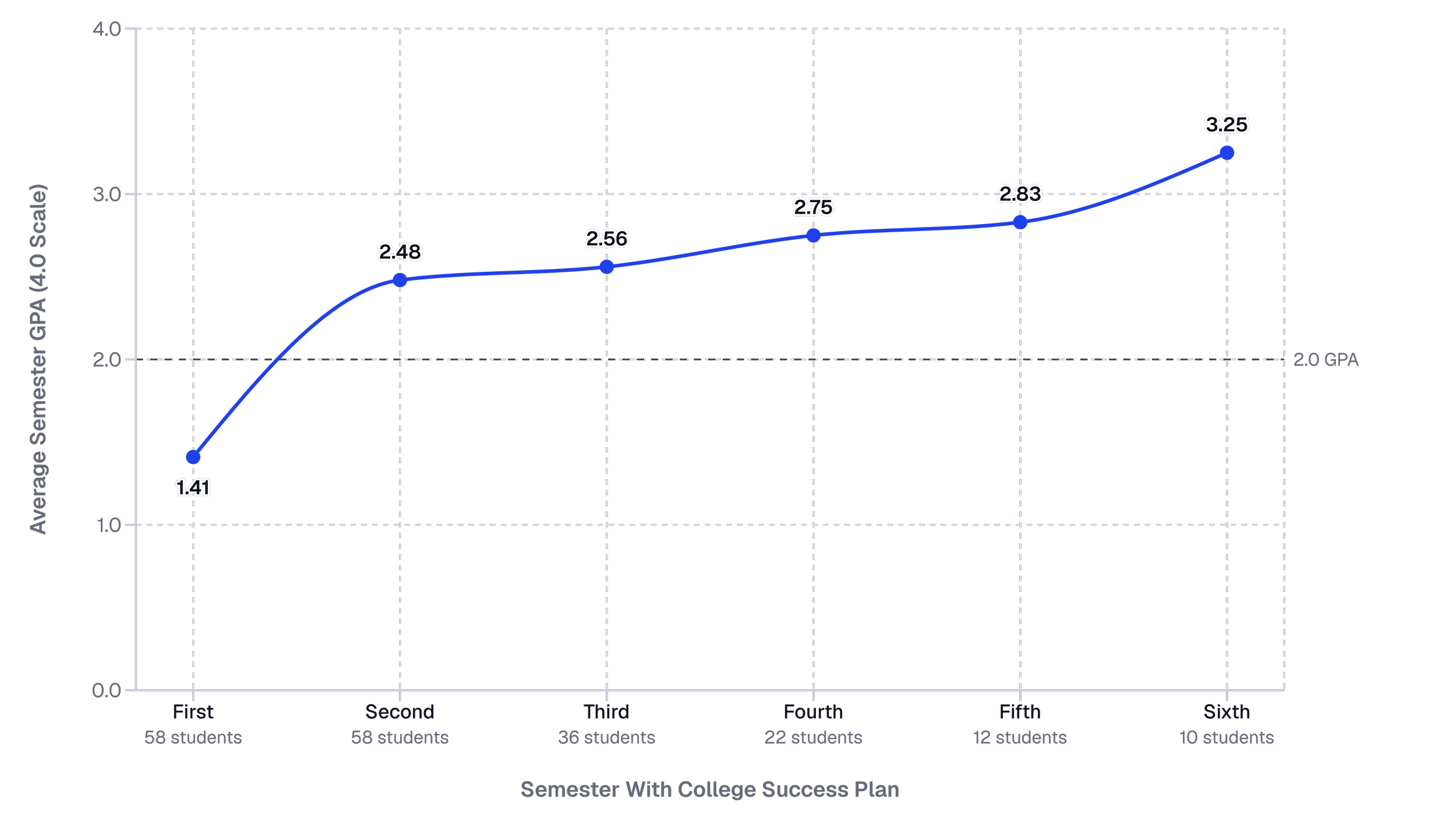
This graph describes 58 students who came to College Success Plan with a GPA below 2.0 and completed a second graded semester; College Success Plan coaching records, Fall 2017 through Spring 2026. Average GPA in each semester with College Success Plan: 1.41 in the first, 2.48 in the second, 2.75 by the fourth, and 3.25 by the sixth. All 58 students have a second graded semester on file, 22 have a fourth, and 10 have a sixth. GPAs are on a 4.0 scale, and the figures were compiled on September 16, 2026.
| Semester with College Success Plan | Students with a GPA on file | Average semester GPA | At or above 2.0 | At or above 3.0 |
|---|---|---|---|---|
| First semester | 58 | 1.41 | 0 of 58 (0%) | 0 of 58 (0%) |
| Second semester | 58 | 2.48 | 42 of 58 (72.4%) | 21 of 58 (36.2%) |
| Third semester | 36 | 2.56 | 29 of 36 (80.6%) | 17 of 36 (47.2%) |
| Fourth semester | 22 | 2.75 | 19 of 22 (86.4%) | 12 of 22 (54.5%) |
| Fifth semester | 12 | 2.83 | 10 of 12 (83.3%) | 6 of 12 (50.0%) |
| Sixth semester | 10 | 3.25 | 10 of 10 (100%) | 6 of 10 (60.0%) |
The chart and table above display academic performance across every semester from the first through the sixth, with the number of students at each stage: 58 students have a second graded semester on file, 36 a third, 22 a fourth, 12 a fifth, and 10 a sixth. The third and fifth semesters, at 2.56 and 2.83, continue the climb, and the average GPA does not decline at any recorded semester.
The percentage of students in good academic standing consistently increases at each milestone. In the second semester, 42 of 58 (72.4%) were at or above a 2.0. By the fourth semester, 19 of 22 (86.4%) reached this mark. By the sixth semester, all 10 students were in good standing. The share of students achieving a 3.0 or higher follows a similar upward trajectory, increasing from 21 of 58 (36.2%) in the second semester to 12 of 22 (54.5%) by the fourth, and 6 of 10 by the sixth.
The most substantial single improvement occurs immediately, from a 1.41 in the first semester to a 2.48 in the second. The subsequent growth is steadier and consistently positive. The underlying reasons for this sustained improvement are explored later on this page.
How do College Success Plan students perform overall?
Across all enrolled students, the average outcome is a semester GPA near 3.0. Students who begin their college journey with College Success Plan coaching and remain for at least two semesters average a 3.2 GPA. These are the students and families who initiated coaching proactively rather than reactively, and they are the highest-performing group in the dataset.
Since 2009, student retention in College Success Plan's program has remained strong. Students and their families often make a deliberate decision to return for a second semester of coaching, or longer, after seeing what their first semester with our team produced.
Parents also experience significant positive changes. In our parent questionnaires, 81% of respondents (109 of 134) reported relief from monitoring their student's progress, reduced stress, or an improved relationship with their student. For many families, this is the primary goal: transferring weekly accountability to a coach allows parents to return to simply being parents.
How does College Success Plan measure these results?
Every metric on this page is derived directly from College Success Plan's internal coaching records, with one record per student per semester, with each semester GPA recorded exactly as it stood at the time. Our methodology is straightforward:
A record constitutes one student, one semester, and one GPA. Semesters lacking a recorded GPA are excluded entirely; they are never calculated as a zero. Consequently, the program averages and the percentage of students at or above a 3.0 are based exclusively on semesters with verified grades.
"Came to us below 2.0" indicates that the student's first graded semester with College Success Plan fell below a 2.0 GPA. "Stayed" means the student completed a second graded semester with the program. "Most recent semester" refers to the latest semester with a grade on file for that individual student, regardless of whether it was their second or eighth semester.
We publish these figures alongside our sample size and methodology so that parents, counselors, and clinicians can evaluate them independently; and we do not publish data by individual coach or college. While College Success Plan's records grow with each semester, everything on this page is current as of September 2026.
What does the research say about executive function coaching for college students?
Published research indicates that weekly one-on-one coaching builds essential study strategies, self-regulation, and persistence in college students. Below is a summary of the most robust studies in this field.
Controlled trials find coaching strengthens study strategies and self-regulation
The one randomized trial evaluating weekly coaching for college students with ADHD is Field, Parker, Sawilowsky and Rolands (2013), published in the Journal of Postsecondary Education and Disability. This study randomized 160 students across ten campuses to receive either 24 weeks of 30-minute weekly phone coaching or placement in a comparison group. After six months, the coached students reported significantly better study strategies, self-regulation, and overall well-being compared to their uncoached peers. The trial did not measure grades, earned credits, or retention rates.
The largest trial of a structured program is ACCESS, detailed by Anastopoulos and colleagues (2021) in the Journal of Consulting and Clinical Psychology. This study tracked 250 students with rigorously diagnosed ADHD across two universities. Students were assigned to group instruction in cognitive behavioral skills, paired with weekly 30-minute individual mentoring over two semesters. The program produced medium-to-large gains in managing ADHD symptoms and executive functioning that sustained through the second semester. ACCESS relies on cognitive behavioral therapy paired with mentoring by clinicians in training rather than standard coaching. A companion paper by Eddy and colleagues (2021) in the Journal of Clinical Child & Adolescent Psychology found that GPA and credits earned did not change significantly over the two semesters for either group.
Two comprehensive reviews echo these findings. Ahmann, Tuttle, Saviet and Wright (2018), publishing in the Journal of Postsecondary Education and Disability, reviewed 19 outcome studies of ADHD coaching, ten of which focused on college students. While all 19 studies reported improvement in ADHD symptoms or executive functioning, the reviewers noted that the evidence base remains thin: 15 of the 19 studies lacked a control group, samples were small, and only one study examined GPA. More recently, Anderson and Marino (2024), in the same journal, reviewed 17 studies published between 2009 and 2021. Reviewing sample sizes ranging from 2 to 1,782 students, they reported positive outcomes, including improved GPA, time management, and organization, but again cited small sample sizes as a primary limitation.
The largest uncontrolled series is Prevatt and Yelland (2015) in the Journal of Attention Disorders. Evaluating 148 college students who completed eight weekly coaching sessions, the study found significant improvement across all ten measured study and learning strategies. The authors concluded by calling for further randomized trials.
Students offered one-on-one coaching are more likely to stay enrolled
The strongest evidence linking coaching to continued college enrollment comes from studies of general student populations, rather than specific ADHD samples. Bettinger and Baker (2011), a National Bureau of Economic Research working paper later published in Educational Evaluation and Policy Analysis, evaluated 17 randomized lotteries encompassing 13,555 predominantly nontraditional students. The results demonstrated that students offered one-on-one coaching were 5.2 percentage points more likely to remain enrolled after six months (63.2% versus 58.0%) and 3.4 points more likely after 24 months.
The baseline for these outcomes is established by a four-year study of 406 students at four-year universities, conducted by DuPaul and colleagues (2021) in the Journal of Clinical Child & Adolescent Psychology. Students with ADHD entered with first-semester GPAs of 2.81 (unmedicated) and 2.93 (medicated), compared to 3.24 for peers without ADHD. Notably, receiving academic support services predicted a better long-term trajectory for unmedicated students with ADHD. A related paper, Gormley and colleagues (2019) in the Journal of Attention Disorders, noted that standard academic services typically available on campus were not independently correlated with first-year GPA improvements for students with or without ADHD.
Taken together, the research clearly establishes what coaching effectively builds: study strategies, self-regulation, and persistence. However, controlled trials have not yet proven that coaching independently raises grades. That specific gap is precisely what College Success Plan's internal records are designed to address for our own students, utilizing our specific methodologies.
Why does executive function coaching with College Success Plan work?
College Success Plan coaching consists of a weekly, one-on-one session between your student and a dedicated coach throughout the entire semester. As our College Success Coaching page emphasizes, "Our pillars of accountability, structure, and consistency get the job done."
These three pillars provide the framework that a student struggling with a 1.4 GPA previously lacked.
Accountability ensures someone follows up on every commitment made the prior week.
Structure dictates that deadlines are mapped on a calendar and each week is guided by a written plan.
Consistency means the student meets with the same person at the same time every week, ensuring the plan is continuously revised rather than abandoned.
Within this framework, the coach builds the nine core skills of executive function: planning, organization, task initiation, time management, prioritization, self-regulation, self-monitoring, self-advocacy, and cognitive flexibility. As noted in our FAQ, "the majority of our coaches have master's level or higher degrees in the educational field," and many are "accredited through the Rush NeuroBehavioral Executive Function Center."
The research aligns with this progression. In the Field trial, the specific metrics separating coached students from uncoached ones after six months were study strategies, self-regulation, and well-being, the foundational behaviors necessary for academic achievement. Our records demonstrate the typical downstream effect: an initial climb from a 1.41 to a 2.48 in a single semester, followed by steady, continued growth.
Our article What Happens in an Executive Function Coaching Session details this process minute by minute. If you are uncertain whether a private coach is the right choice, or if your student might thrive using existing campus resources like the writing center or disability services, our guide Private Coach or Campus Resources can assist your decision. Campus support is the right answer for many students, and we readily acknowledge that.
What do these results not promise for your student?
College Success Plan's historical outcomes do not guarantee a specific future grade. The figures presented on this page describe a precise cohort: 58 students who arrived with a GPA below 2.0 and continued with the program, alongside the broader dataset surrounding them. They do not promise a specific GPA or guarantee a return to good academic standing for any individual student. Every student's trajectory is unique, and an "average" result simply means there are students who perform both above and below that baseline.
Typically, a student's engagement during the first month indicates whether the coaching is effective long before final grades are released. Effectiveness is demonstrated through behavioral markers: attending scheduled sessions, actively engaging with a weekly plan, and demonstrating a willingness to share syllabi and learning management systems. The session walkthrough outlines these markers in detail under the section "What It Looks Like When Coaching Is Not Working."
Furthermore, coaching is not a substitute for formal academic accommodations, disability services, advising, or professional counseling. Accommodations are an entitlement your student registers for directly with the college. A student experiencing a mental health crisis must prioritize campus counseling centers or a clinical professional first. Coaching is designed to work alongside or after these vital services, never as a replacement. The guide Is College Success Plan For You? helps clarify whether our coaching is the appropriate fit for your student's specific needs.
How to start with College Success Plan
The first step is a free consultation. During this call, you describe your student's academic experiences thus far, and we evaluate whether our coaching is a strong fit while outlining a potential starting plan. You can then make an informed decision with no obligation.
If you believe your student would benefit from executive function coaching, schedule a free consultation, or read more about College Success Coaching first.