

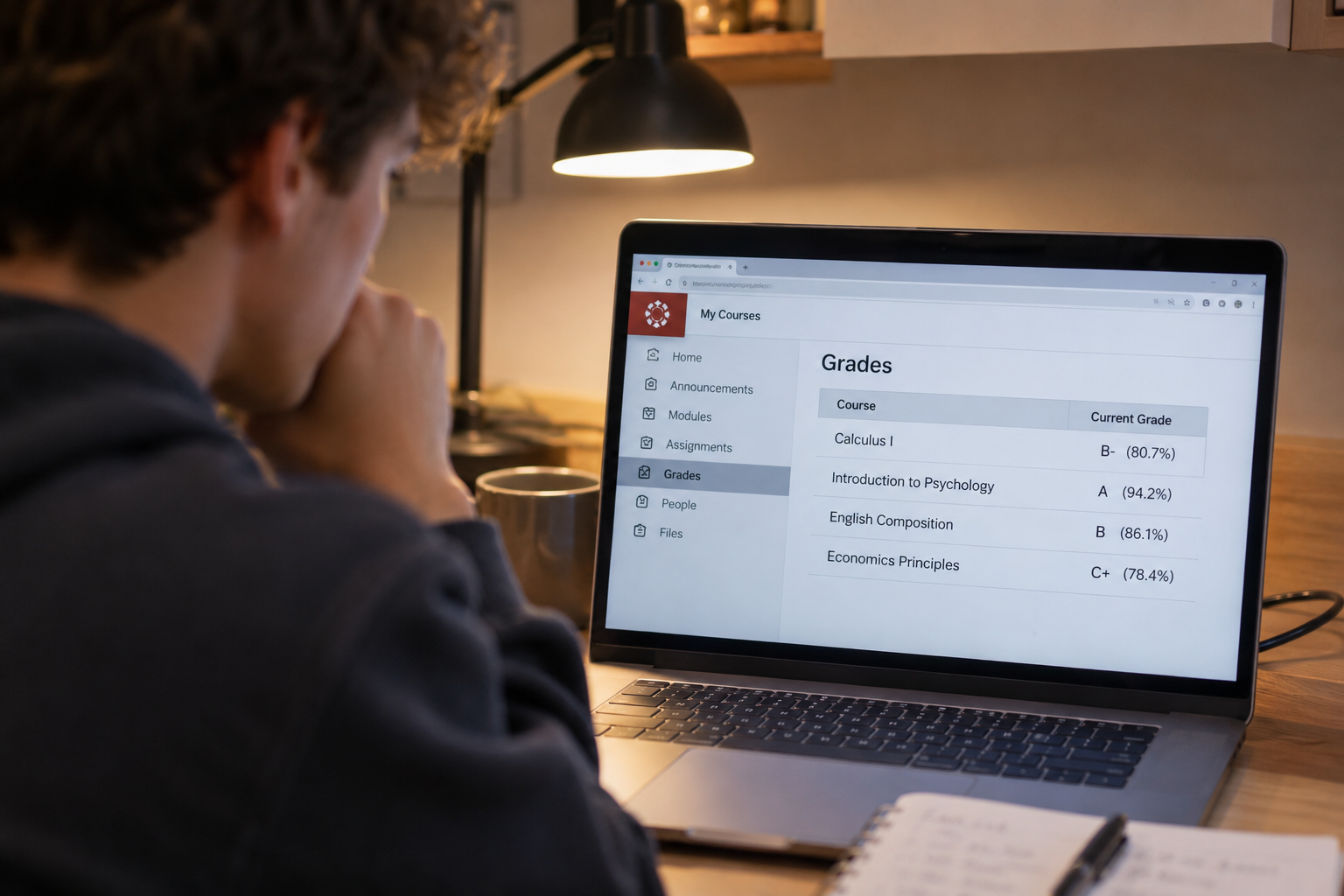
The last weeks of the fall semester are full of open questions: the grade not yet posted, the exam not yet seen, the class that could still go either way. A new meta-analysis in JAMA Psychiatry found that college students' difficulty tolerating that kind of not-knowing rose steadily from 1992 to 2023, and rose about three times faster after 2012 (van Baar et al., 2026).
What Did the New Study Find?
Researchers at Boston University School of Public Health and Columbia University Mailman School of Public Health pooled 137 studies of young adults attending college in the United States and Canada, covering 37,298 participants (van Baar et al., 2026). Each study had measured intolerance of uncertainty with a version of the same standard questionnaire, which let the team track average scores across three decades.
The average rose across the whole period. The rate of increase from 2012 to 2023 was three times the rate from 1992 to 2011. The authors conclude that intolerance of uncertainty increased among college students, with a steeper climb after 2012, and that its role in anxiety deserves further study.
In Columbia's announcement of the study, senior author Katherine Keyes, PhD, said the consistent increase mirrored trends in anxiety and mood disorder symptoms. That pattern, she said, suggests those trends are unlikely to be explained only by greater mental health awareness (Columbia University Mailman School of Public Health, 2026). The team added that reducing intolerance of uncertainty may help curb the rise of anxiety and mood symptoms among young adults.
What Is Intolerance of Uncertainty?
The study defines it as difficulty enduring the perceived absence of important information. In everyday terms, it is the pull to settle a question right now, even when the answer is not available yet.
Intolerance of uncertainty is not a diagnosis. It is a pattern of thinking that everyone carries to some degree. Keyes described it as "not itself a health outcome or a root cause of disease, but an intermediary cognitive process that contributes to the development of anxiety." That framing matters for parents. A student who hates not knowing is not broken. Your student is responding to ambiguity in a way that can be noticed, named, and practiced.
Researchers often describe two sides of it. One is a strong desire for predictability, which tends to fuel worry. The other is what a 2016 study in the Journal of Obsessive-Compulsive and Related Disorders called "uncertainty paralysis," a sense of being stuck and unable to respond when the outcome is unclear. In that study, procrastination was predicted only by this second, freezing side (Fourtounas and Thomas, 2016).
Why Does Finals Season Turn Up the Volume?
Finals pack more uncertainty into fewer days than any other point in the term. Your student does not know exactly what the exam will cover, whether the preparation was enough, or what the final grade will be.
A 2022 study of 675 college students in BMC Psychology found that intolerance of uncertainty was significantly linked to test anxiety, alongside students' beliefs about worry itself (Huntley et al., 2022). A 2024 study of 853 college students by Ball State University researchers, published in Behavioral Sciences, traced a longer chain. Intolerance of uncertainty tended to activate cognitive test anxiety, which raised the likelihood of academic self-handicapping, which was tied to lower GPA (Cassady et al., 2024). Self-handicapping looks like starting too late or skipping the practice exam, so a poor grade already has an excuse.
At home, it can sound quieter than panic. Your student refreshes the learning management system gradebook at 11 p.m. instead of opening the study guide. The paper that matters most is the one that never gets started, because starting means finding out how hard it is.
What Does the Encouraging News Leave Out?
There is real good news this week as well. The 2025-2026 Healthy Minds Study, based on 67,477 students at 107 colleges and universities, found that 30% screened positive for moderate or severe anxiety, down from 32% the year before. Positive mental health rose from 36% to 43% (University of Michigan, 2026).
These two reports measure different things, and the meta-analysis data end in 2023. Both can be true at once. The same Healthy Minds report found that two-thirds of students said emotional or mental difficulties had affected their academic performance in the previous four weeks, and 12% said they were unsure where to go for care.
A national trend is not your student's week. The useful question is not whether students overall are doing better. It is how your student handles the open questions in front of them right now.
How Can You Respond When Your Student Needs an Answer Now?
When your student calls anxious about an unposted grade, the instinct is to offer certainty: "You'll be fine." That reassurance is kind, but it borrows certainty neither of you has. Try these instead.
Separate the known from the unknown. Ask what is already decided, such as exam dates and grades posted so far, and what is still open. Seeing the list written down often shrinks it.
Plan for the "if." A short if-then plan turns worry into structure: if the chemistry grade comes back lower than needed, then your student emails the professor Monday about options.
Shrink the first step. A freeze loosens when the next action is small and concrete, such as opening one practice exam for twenty minutes.
Set a time to check. Suggest one agreed time to look at the gradebook rather than checking all evening.
Know when to bring in a professional. If worry is persistent, disrupts sleep, or feels unmanageable, the campus counseling center or a licensed clinician is the right next call.
Our post on helping your student through finals week from a distance covers what to say on those late-night calls.
Why This Ties to Executive Function
Tolerating uncertainty draws on several executive skills at once. Cognitive flexibility lets your student adjust a plan while an answer is still unknown instead of waiting for it. Self-regulation keeps worry from taking over the evening. Task initiation gets the study guide open when the outcome feels too uncertain to start. Planning and prioritization turn a cloud of what-ifs into a short list of next steps, and self-monitoring helps your student notice the freeze while it is happening. When these skills are still developing, a capable student can know exactly what to do and still stall. That is a skill gap, not a character flaw. Our explainer on what executive function covers and why college exposes it walks through each skill in more depth.
How Coaching Helps
Our coaches meet with your student every week, with the same dedicated coach, and follow up by text and email between sessions. That steady rhythm gives your student one predictable fixed point in a semester full of open questions. In session, coaches help your student map what is known, make if-then plans for what is not, and break a frozen task into a first step small enough to start. Coaching is not therapy and does not treat anxiety; when a student needs clinical care, coaching works alongside it. Weekly parent updates give you a clearer picture than a single worried phone call, so you can step back from the monitoring role. You can read more in Does Executive Function Coaching Work? The Research and College Success Plan's Results.
Read about College Success Coaching, one-on-one virtual coaching that meets your student every week. Schedule a free consultation to talk through what your student needs this semester.